woensdag 9 juli 2014

SSAS : Partitions in a multidimensional cube

Introduction

When your fact tables grows, consequently your multidimenional cube will grow, too (if you have a multidimensional cube off course). You can increase your performance by splitting up the measures in partitions. Partitions allows you to divide a cube in one or more folders. These folders are usually placed on one or more hard drives for improved performance. Multiple partitions can have the following advantages (mssqltips):
  • Increased performance by placing the partitions on different disks.
  • Each partition can have it's own storage mode.
  • Parallel processing of partitions
  • etc. 
In this blogpost I'll show you how to create partition in SSAS by using the SSAS tutorial of MSDN. In this tutorial a cube is created on AdventureWorks2012DW database. The measuregroup internetsales is divided into partitions by year.

Creating the partitions

Open the cube and navigate to the partitions tab and click on New partition. A screenshot is shown in the picture below. Here you can zsee the standard partitions.


A wizard is opened and the following window appears. click on Next.


Change from Table binding to Query binding. Check the "internet tables" in the box Available tables and press OK


If you change to Query binding the following window is shown.The WHERE statement is not finished yet and there you have to enter your partition range.


The data of AdventureWorks is from 2005 until 2008. Below the first range is entered from 20050101 until 20051231. Now press on check and the messagebox "Syntax check succesful". Press on OK.


Now you have to enter the location of your partition. You can also process the partitions on different servers. Press OK


Do you want to design partitions by aggregating it? In this example I will not do that. Press Finish


Now The first partition is ready and now you can create the next partition.


Finally, when you have done this for 2005, 2006, 2007 and 2008 the partition tab will look like below.


Conclusions

It's is very easy to add partitions to a cube and a simple partition design is very straightforware and simple.


Greetz,

Hennie

vrijdag 4 juli 2014

Microsoft SQL Server 2014 Sample databases

Introduction

Today, I decided to do some study on SQL Server 2014 and I wanted to install the sample databases of SQL server 2014. But, I can't find the sample AdventureWorks databases for SQL server 2014. It seems that the sample databases of SQL Server 2012 are applicable for SQL Server 2014.

By default, sample databases and sample code are not installed during the installation of SQL Server and you have to search, find and download the sample databases.

Sample databases

On Codeplex you can download the AdventureWorks databases for SQL Server. It's quite a list and I grouped the files together.

Relational Databases (OLTP):
  • AdventureWorks2012 Data File
  • AdventureWorks 2012 OLTP Script
  • AdventureWorks2012-Full Database Backup.zip
  • AdventureWorks2012_Data.zip
  • AdventureWorks2012 CS Data File
  • AdventureWorks 2012 CS OLTP Script
  • AdventureWorksLT2012_Data
  • AdventureWorks 2012 LT Script

Databases (DW)
  • AdventureWorksDW2012 Data File
  • AdventureWorksDW2012Images

SSAS MD
  • AdventureWorks Multidimensional Models SQL Server 2012
  • Analysis Services Tutorial SQL Server 2012

SSAS Tabular
  • AdventureWorks Tabular Model SQL Server 2012
  • AdventureWorks Internet Sales Tabular Model SQL Server 201

Here are some other samples for SQL Server I've found so far:

Conclusion

It seems that the sample database of SQL server 2012 are reusable for SQL Server 2014. There are some more samples created specifically SQL Server 2014. But, the adventure Works databases are the same...

Greetz

Hennie

zondag 25 mei 2014

Datavault : Kanban in a Datavault project (part III)

Introduction

I've finished my Lean Six Sigma Orange Belt certification a couple of months ago. For this certification I needed a case study that would justify a certification. I decided to use my project as a base for my certification. In my current project we are developing a analytic platform for analysts with Datavault. We already used a kanbanboard but I thought that some improvements was possible.

We encountered some throughput problems of the implmentations and I decided to investigate our development proces and thought about what could aid speeding up the process. The teammembers discussed our method and we tried to adopt the various techniques of Lean Six Sigma.

One of the subject areas of Lean Six Sigma is Kanban and Kanban can be very useful for making your processes visible and identifying possible bottlenecks in the process. Read more about Kanban on Wikipedia and this free book about Kanban and Scrum. These are very learnful.

This is the approach I have taken (with the development team) in order to develop a (new) Kanban board:
  • Identifying the steps we take in the development process?
  • What do we do when we build Datavault implementations (the objects) ?
  • Who are the customers and who are the suppliers in the process?
    • Supplier, Input, Process, output and Customer  (SIPOC).
  • What are the criteria for moving a card from one phase to another?

This blogpost is one in a series of blogposts about datavault:


Task analysis

At first We decided to take a look at our activities in the project. What are the activities in the project? Well, We came up with this list:
  • Analysis (gaining knowledge)
    • Deskresearch
    • Data-analysis
    • interviews
  • Design
    • Datamodeling (Conceptual, logical, SourceVault and  BusinessVault)
    • ETL
  • Development (DDL + ETL Packages)
    • StagingIn
      • Tables
    • SourceVault
      • Hubs
      • Links
      • Sats
      • EndSats (Effectivity)
      • Refs
      • Other DV Tables
  • Build (DDL + ETL packages)
    • BusinessVault
      • Hubs
      • Links
      • Sats
      • EndSats
      • Refs
      • Other DV Tables
  • BusinessAccessLayer
    • Development (ETL packages)
    • Entities
  • ProcessFlows
    • MasterProcess flows (PCF and MPCF)
    • Input file processing (IFP)
    • StagingIn
    • SourceVault
    • BusinessVault
  • Initial loads (This is for going back in time and resample (historize) the data).
  • ProcessManagement
    • Configuration
  • Test
    • Systemtest
    • Acceptancetest
  • Documentation
    • (Conceptual Datamodel)
    • SourceVault Datamodel
    • BusinessVault Datamodel
    • Functional and Technical descriptions
    • SSIS packages
  • Additional
    • Supply contracts with the datasuppliers

SIPOC

The next step was investigating our working process. What are our phases we actually executing during development of a deliverable? And what were the criteria for moving from one phase to another?


The next step was studying the SIPOC (supplier, Input, Process, Output and Customer). With SIPOC you have a tool that help you to improve a process. This is mostly used during the Define phase int he DMAIC process.


I noticed that there are two kinds of output in a process: Work and Criteria. The criteria says something about go/no go decisions and work is about delivering value to the valuestream, for instance a Datavault model.

The Kanban board

The next step we took was designing a new Kanban board, based on the taskanalysis and the SIPOC schema. I made some designs of the board and We had quite some discussions about the board. The discussion was about finding a balance between not too simple but also not too complicated. If it was too simple it will not help us understanding the process and if it was too difficult people wouldn't accept the board. We finally made this board:


Phases
We have defined the columns as identified (more or less) in the SIPOC schema during the Define process : Analysis/design, Develop, build, test, QA, Ready for production and Production.

Lanes
We introduced two kinds of lanes: Projectlanes and fastlanes. Fast lanes were intended for high priority issues that had a higher priority than the projects that we were running.

Definition of Done (DoD)
And the last part that we added to the board was a Definition of Done row. This DoD were the criteria in the SIPOC schema. These criteria helped us describing the DoD. This helped us agreeing about when a card should be moved from one column to the other, as a group.

The result

Finally, we created a new kanban board. This is shown below.


Conclusion

Kanban can be very useful in a project with a number of teammembers. Developers have to tell something about what they are doing, the impediments they have and what they are planning to do. A Kanbanboard can be very effective when all members of team are working with one goal: deliver value within a certain period of time. I think it's less effective when all members are working on their own deliverable and with their own deadline. When teammembers are working on a collaborative goal more co-operation  and more synergy effects will happen

Greetz,
Hennie

dinsdag 22 april 2014

Datavault : Adaptability of the Datavault model (Part II)

Introduction

This is the second blogpost in a series about Datavault. The first blogpost in this series was about the basics of Datavault and in this blogpost I would like to discuss the adaptability of the datavault model. Why is Datavault an adaptive method for designing your datawarehouse? I think there are three reasons why Datavault is an adaptive Datamodel approach:
  1. A fundamental reason: Separating the keys, relationships and the descriptive data in separated tables enhances the flexibility and agility of the model.
  2. You can easily add Satellites (within a Concept) to the model without breaking the existing model.
  3. You can easily add Links (a new Concept or a new Concept Constellation) to the model without altering the existing model.

In this blogpost I'll discuss the adaptive characteristics of the datavault model in more depth..

Adding Satellites

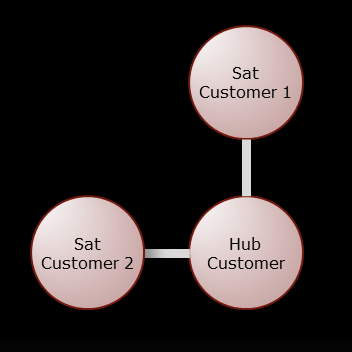
A satellite doesn't contain businesskeys. It stores (all)  information about the businesskey (hub) and historizes all the information about the concept. It inherits the surrogate key of the hub (or link). In order to historize, the primary key is extended with a Date/Time Stamp. In this way the Satellite acts as a Type II dimension (SCD2). The Satellite stores every change that happens in the source.


Now let's see what happens when structural changes happens in a operational system that acts as a source for a datavault data warehouse.

1) Initial situation. 
In this initial situation there is a hub and one satellite. This situation occurs most often during the start of a data warehouse in a production state. The hubs and satellites are designed and ready for usage.


2) Extra attributes added to a table in the sourcesystem.
Now, something happens in the operational system. Some tables are extended with extra fields. These extra fields should be propagated to the data warehouse. Now, the strength of the data vault model shows up. Nothing changes to the exisiting model. The extra fields should not be integrated in the existing satellite but create a new satellite and add this to the hub. Integrating the fields in the existing satellite causes difficulties like dropping and recreating the table.


On Linkedin I had a discussion about changing source systems..I'll blog about this in the future.

Adding Links

The same is true for links. The hubs are the anchors of the model. These anchors provide steadyness of the model and anchors provide satellites and links with surrogate keys. Below and example of a link table and a hub table. The hub provides the link with a surrogate key and this principle helps to connect other concepts and other concept constellations (see part I).


Suppose you have the following situation. There is an old piece of data warehouse and a new piece (concepts) of data warehouse is build.


Now another advantage of the Datavault comes into play. The new concept is linked by the link tables with the old piece of the data warehouse. And, nothing changes in the current datawarehouse. Starmodels, reports and analysis build on top the Datavault model continues to function properly.


Conclusion

The Datavault model is adaptive because of the separation of the businesskeys, the relations and the descriptive information. If you condense the data like the star model, the model will become less adaptive. It will be harder to change the model. By separating the different kinds of data, the model become more resilient to changes. By adding satellites and links to the model and not changing current satellites and links (and hubs) the current reports and (user) queries will remain running. This way the datavault model lends itself for extending the model without breaking the current model. 


The star schema is less flexible for storing datawarehouse information because we have only two flavours: Facts and dimensions. Therefore Datavault is more suitable for storing datawarehouse information than star schemas.

Greetz,
Hennie

vrijdag 18 april 2014

Hadoop summit 2014 review

Introduction

Couple of weeks ago I joined the Hadoop summit 2014 in Amsterdam. I enjoyed most of the sessions and I've learned new stuff and it gave me more insights in the usage of Hadoop.The world of data is changing and it will happen fast, as it seems, according to some speakers at the Hadoop Summit. The data paradigm is shifting from Schema-on-Write (RDBMS) to Schema-on-Read (Hadoop). This paradigm shift is happening at this moment. We will see for certain types of data the Schema-on-Read will become popular in favorite of Schema-on-Write solutions. Most of these types of data are unstructured or semi-structured.

And, it's not about new technology replacing old technology, it's also about creating new businesses with new technology. With Hadoop there are new business opportunities possible with new ways of developing business models based on Hadoop and together with RDBMS solutions (for now).


DataOS

With the launch of YARN (Yet Another Resource Negotiator) the name of DataOS appeared. YARN is called DataOS. In 2012, YARN became a sub-project of the Apache Hadoop project. YARN is a software rewrite that decouples MapReduce's resource management and scheduling capabilities from the data processing component. This enables Hadoop to support more different processing approaches and a broader array of applications.


RDBMS living together with HADOOP

How about RDBMS and Hadoop?  YARN replaces Mapreduce and it isn't a batch oriented system but also a real time solution. Storm is an example of this. I think dat future developments of Hadoop will lead to a change of the design of the Enterprise Data Warehouse. But for now, in the referential architecture of Hortonworks RDBMS and Hadoop live together and they both borrow data from each other. The photo below shows you this (sorry for the bad photo).


This is also the case with the PDW v2 solution of Microsoft. In this appliance Microsoft already sells Hadoop as an integrated part. Polybase is the layer that abstracts the Hadoop and the MS nodes. So, In one solution a RDBMS and a Hadoop solution with an uniform layer. That's nice.


Conclusions

The Open source community of Hadoop has become huge and practically every vendor embraces this new technology. Microsoft gave up there Hadoop look-a-like software (Bing) and has embraced Hadoop and integrated this in PDW v2 (The modern Datawarehouse). There are new Hadoop developments like YARN, Stinger, TEZ, Storm.

As for integrating Hadoop into your Enterprise Data warehouse I can imagine that Hadoop will become a base for capturing raw data into a (historically) Staging Area. Hadoop is about storing Raw data and it's cheap. You can Build on top of that a Business datawarehouses and a discovery- and analytical platform for analyzing structured and unstructured data.

Greetz,

Hennie